
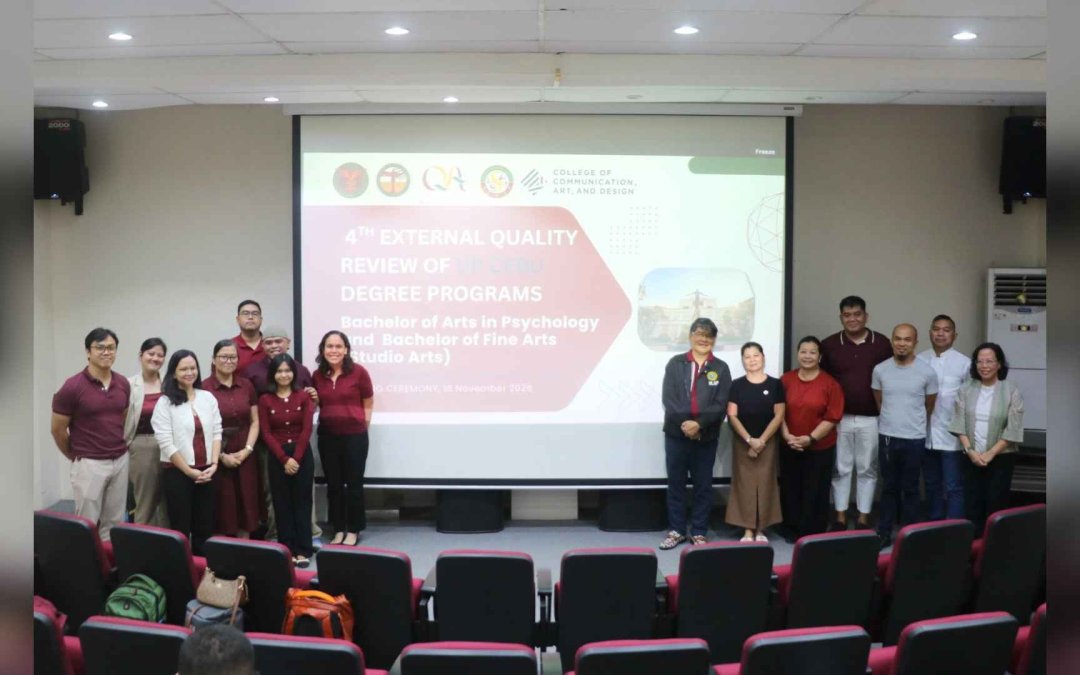
Welcome Remarks of Chancellor Leo B. Malagar during the 4th UP Cebu External Quality Review (BA Psychology and BFA Studio Arts)
Maayong buntag kanatong tanan!
To our distinguished external reviewers, Professor Philip Ian Padilla, Professor Susan Festin, Professor Myra Borines, and Associate Professor Riza Romero; our Vice Chancellor for Academic Affairs, our deans, faculty, staff, students, and colleagues in quality assurance, welcome to the University of the Philippines Cebu.
We are grateful to our colleagues from UP Visayas, UP Diliman, and UP Los Baños for sharing their time, expertise, and wisdom with us.
Today, we open our University once again to the discerning eyes of our colleagues from across the UP System.
A university secure in its mission must never be afraid of the truth about itself.
We welcome this review because we wish to understand how much better we can become.
The AUN-QA Programme Assessment Framework, particularly Criterion 1 and Requirements 1.1, 1.4, and 1.5, reminds us of three fundamental obligations: that our learning outcomes reflect our institutional vision and mission; that they respond to the needs of our stakeholders, especially those outside the University; and that our students actually achieve these outcomes by the time they graduate.
These three requirements bring us back to three fundamental questions: Who are we as a university? Whom do we serve? And are we delivering on the promise we have made?
For UP Cebu, our vision, mission, and strategic plans must find expression in what our students learn, in what our faculty teach and create, and in the difference our University makes in society.
Today, we examine two programs that speak profoundly to the human condition, two programs with distinguished histories and meaningful contributions to our region.
Our Psychology program has produced graduates who have become leaders in human resources, counseling, research, education, and psychological practice. Our Fine Arts program, founded in 1975, has nurtured generations of artists and contributed to the cultural life of our region and nation.
Psychology helps us understand human behavior, develop human potential, and build healthier, more humane, and more effective organizations.
Studio Arts challenges us to see the world differently, to give expression to our cultural identity, and to imagine what is possible.
We take pride in what these programs have accomplished. But quality assurance asks us to look beyond what we have achieved and consider what more we can become.
Both programs have much to contribute to the future of Central Visayas. But their relevance begins much closer to home.
As we pursue the redevelopment of our campus, we must remember that we are building more than buildings. We are building a community.
Allow me to share what our recent community profiling reveals.
The profiling undertaken by Cebu City’s Division for the Welfare of the Urban Poor in Lahug and Kamputhaw has recorded 808 beneficiary entries, including 134 in the UP personnel register.
The records also identify 154 extended-family entries. Among our own UP personnel, 57 are listed as renters and 51 as owners of residential structures. These figures remind us that housing is a concern shared by our communities and our own University employees.
What is particularly revealing is that many of the homes documented are already semi-concrete and multistorey structures. These are communities that have grown over many years, with families investing in their homes, establishing businesses, building relationships, and creating their own sense of belonging.
These preliminary figures are still being reconciled. But behind these numbers are real people. Families who have lived here for decades. Vendors, drivers, workers, small business owners. Our own colleagues who serve this University and dream of having a decent home.
We are not planning the redevelopment of vacant land. We are planning the future of an existing community.
A family renting a small room, a multigenerational household sharing a home, a vendor whose livelihood depends on this community, and a University employee seeking affordable housing do not necessarily need the same solution.
If quality assurance begins with knowing our stakeholders, then surely these are among the people we must know, understand, and listen to.
We envision a University where informal settler families who have made their homes on University property become partners in development; where progress for the University need not mean displacement; and where their livelihoods, small businesses, and quality of life can improve as the University grows.
We envision a campus where our faculty and staff can have access to decent housing, opportunities for additional income, and a better quality of life, while living within the very community they serve.
One University. One community. A shared future.
What can Psychology contribute to building such a community? How can Studio Arts help us create spaces that affirm human dignity, nurture creativity, and foster a sense of belonging?
Can our Psychology students, working with these families, help us understand their aspirations, strengthen community organizations, develop human potential, and support sustainable livelihoods?
Can our Studio Arts students work with these communities to preserve their stories, give expression to their identity, and imagine public spaces where students, faculty, staff, and residents can live, learn, create, and thrive together?
Here, within our own University, is an opportunity to bring teaching, research, creative work, and public service together.
It is an opportunity for our students to apply what they learn, and for our University to learn from the very people it seeks to serve.
This vision of community engagement is not separate from our pursuit of academic quality. It is one way of giving life to the very framework that guides our review.
Under Requirement 1.5, our students must demonstrate by graduation that they have achieved their expected learning outcomes. Community-based projects, when properly designed and assessed, can provide meaningful evidence of that achievement.
Criterion 3, particularly Requirements 3.3 and 3.5, calls for active learning, creative thought, innovation, and an entrepreneurial mindset. What better place to bring these commitments to life than within our own campus community?
Criterion 8, particularly Requirements 8.3, 8.4, and 8.5, asks us to monitor and improve our research and creative work, demonstrate the achievement of program outcomes, and assess the satisfaction of our stakeholders.
Imagine a University where our students demonstrate what they have learned through work that contributes to stronger community organizations, sustainable livelihoods, meaningful creative expressions, and a better quality of life.
Imagine a University where the communities we serve become our partners in defining the problems, developing solutions, and assessing the results of our teaching, research, and creative work.
When our students learn through service, when our research responds to human needs, and when our creative work enriches the lives of our people, our vision and mission cease to be mere statements. They become lived realities.
Is this not what quality education in a public university ought to be?
These, too, are questions of quality.
To our reviewers, I offer our hospitality and our openness. Examine us rigorously. Question us freely. Tell us what we need to hear.
You do not honor us by telling us only what we do well. You honor us by helping us see what we can do better.
To our faculty and staff, thank you for the often unseen labor that has brought us to this day. To our self-assessment teams, and to the students, alumni, and partners who will speak with our reviewers: thank you. Your candor is our best evidence.
And to our university leadership, myself included, let us remember:
The true measure of a quality review is not the rating we receive, but the lives we improve long after the reviewers have gone home.
Our excellence must be felt by our students, our faculty and staff, the families who have made their homes within our campus community, and the communities of Lahug, Kamputhaw, and the wider region we are called to serve.
We aspire to stand among the finest universities in the world. We must continue to measure ourselves against the highest international standards.
But let us never lose sight of what matters most.
Our highest ambition is not to top the QS rankings. It is to be number one in the hearts and minds of the Filipino people, beginning with the people of Cebu and Central Visayas.
And we must earn that place every day, not through the reputation we proclaim, but through the lives we improve.
That is the quality we must pursue.
That is the promise we must keep.
Welcome to UP Cebu.
Daghang salamat!