Text and Photo by Eunice Iglesias/StoryLab
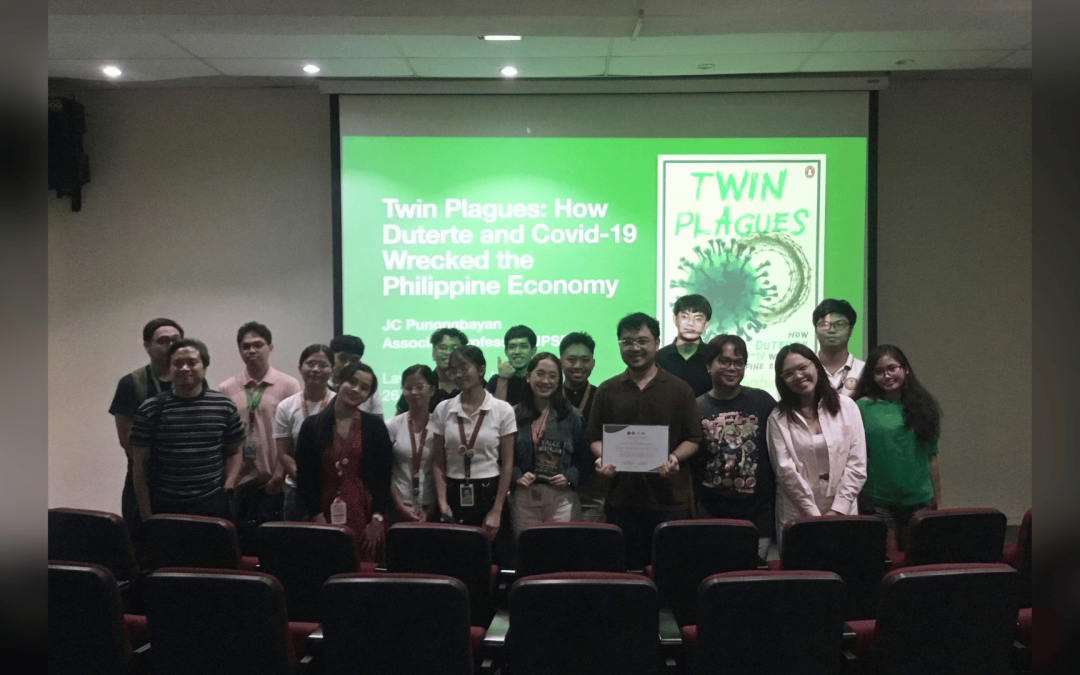
Weakened public systems and militarized governance under former President Rodrigo Duterte (2016–2022), rather than the COVID-19 pandemic alone, drove the Philippines into its worst economic crisis since Martial Law, according to Assoc. Prof. Jan Carlo B. Punongbayan of the UP School of Economics, during a book talk and forum at the Lawak Sinehan last September 26.
Hosted by the UP Cebu Office for Initiatives in Culture and the Arts (OICA), the event centered on Punongbayan’s latest book, Twin Plagues: How Duterte and COVID-19 Wrecked the Philippine Economy, published by Penguin Random House SEA, the regional arm of Penguin Random House dedicated to expanding the reach of Southeast Asian literature across linguistic and geographic barriers.
Punongbayan opened with a review of the Philippine economy before 2020, when strong growth coexisted with rising inflation, policy uncertainty, institutional erosion manifested through attacks on independent media and a violent drug war, and underperforming infrastructure projects.
The discussion then turned to the government’s pandemic response, which he characterized as heavily militarized and arbitrary.
He cited reliance on military generals rather than medical experts, unevenly enforced quarantines, policy decisions lacking clear scientific backing, and controversies over multi-billion-peso emergency funds, including the Pharmally scandal.
What could have been a contained health emergency became a long-term burden, as extended school closures deepened learning losses and threatened students’ skills, wages, and opportunities for decades. According to him, these costs fell hardest on the poorest sectors of society.
Contrasting the Philippines with neighboring countries that avoided deep recessions through targeted interventions, Punongbayan also challenged the idea that governments had to choose between protecting lives and preserving livelihoods.
Beyond economic analysis, Twin Plagues also serves as a necessary reckoning with recent history and the consequences of failing to hold past leadership accountable.
“We need to put all of this into writing because we risk another wave of false nostalgia,” Punongbayan stressed, drawing parallels between Ferdinand Marcos Sr. and Rodrigo Duterte, whose authoritarian legacies continue to be romanticized despite documented failures.
During the open discussion, he stressed that facts alone may not change minds and that economic data must be grounded in human stories.
With the 2028 elections ahead, he urged voters to look beyond personality and political ties and examine what candidates actually propose for the economy.
The forum concluded with a ceremonial recognition and book signing.
The event formed part of Punongbayan’s Cebu tour for Twin Plagues, his second title following False Nostalgia: The Marcos “Golden Age” Myths and How to Debunk Them. Beyond academia, he is also a Rappler columnist, co-founder of Usapang Econ, and co-host of the Usapang Econ Podcast.