
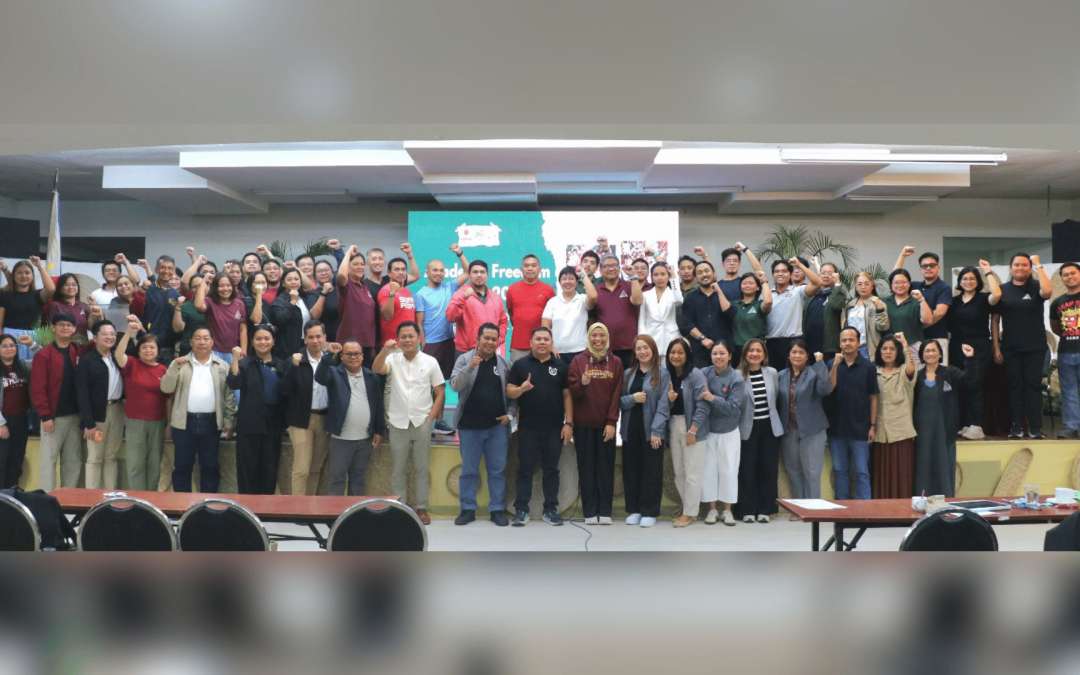
2026 Visayas-Mindanao State Universities and Colleges Faculty and Staff Summit Welcome Remarks
by Chancellor Atty. Leo B. Malagar
To our organizing partners from ACT Teachers Party-List, ACT State Universities and Colleges, the All UP Academic Employees Union, our faculty and staff unions and associations, my fellow SUC presidents, chancellors and administrators, and delegates from across the Visayas and Mindanao—
Welcome to the University of the Philippines Cebu.
Public higher education is being asked to educate more students, produce more research, serve more communities, and help solve the problems of our country.
But we cannot keep asking more from our universities without asking what the people who make them work need in order to deliver.
Our faculty and staff continue to confront very real concerns: insufficient plantilla positions, contractualization, inadequate compensation and benefits, heavy workloads, limited opportunities for professional growth, and institutions working within limited resources.
And so we begin with a simple truth:
There can be no quality education without quality conditions for the people who deliver it.
When enrollment grows but faculty and staff positions do not, the work is carried by fewer people.
Classes grow larger.
Workloads grow heavier.
Time for students, research, mentoring, and service becomes smaller.
Plantilla positions are not simply about creating jobs.
They are about building the human capacity a university needs to fulfill its mandate.
Public service may require sacrifice.
But sacrifice must never become the employment policy of the State.
If we want excellent universities, we must attract excellent people—and give them reasons to stay.
And when our people are stretched too far, something eventually gives.
Excellence built on exhaustion is not sustainable excellence.
Free tuition, important as it is, cannot by itself guarantee quality education.
Free tuition opens the door.
Quality determines what happens after the student enters.
This is why the budget matters.
Two days ago, the proposed national budget for 2027 was submitted to Congress.
The debate is beginning.
The priorities are being decided.
This is the time for public higher education to speak.
And there is something those of us in State Universities and Colleges understand very well.
For Free Higher Education deficiencies alone, the June 30 CHED-DBM-UniFAST guidelines require multiple certifications, detailed billing documents, budget records, governing-board-approved financial documents, and individual registration records.
Claims still undergo evaluation and validation, and only complete submissions are included in the Special Budget Request.
And so—
We know what it means to pass through the eye of the needle just to receive funds that are already meant for education.
We prepare the documents.
We certify the enrollment.
We validate the billings.
We secure approvals.
We account for every peso.
And rightly so.
We do not ask to be exempted from scrutiny.
Hold us accountable.
Audit us.
Require us to explain where every peso goes.
Because public office is a public trust.
And every peso entrusted to government must be accounted for.
But apply that same rigor everywhere.
If a State University must prove every student, every billing, every claim, and every peso before legitimate education funds can be released, then surely every government project must prove every structure, every accomplishment, and every peso before public money is paid out.
The Department of Budget and Management has acknowledged the need to prevent a repeat of the flood-control scandal and tighten accountability against budget abuse.
So our people are entitled to ask:
Why does money for education sometimes have to pass through the eye of the needle, while questionable projects can travel so far through the system before the red flags finally stop them?
This is not an argument for less accountability in our universities.
It is an argument for equal accountability everywhere.
The same rigor.
The same documentation.
The same vigilance.
The same consequences.
Accountability cannot be rigorous in one part of government and porous in another.
It must be strongest where public money is easiest to lose.
That is why corruption steals thrice.
First, it steals the money.
Second, it steals what that money could have become:
a classroom,
a scholarship,
a faculty position,
a laboratory,
a service to a community.
And third, it steals our future.
The future of the student who could have been educated.
The future of the researcher who could have discovered something.
The future of the family that education could have lifted from poverty.
That is why education must never be made to pay the price for corruption.
And this is where I ask all of us to stand together.
Faculty and staff.
Union leaders and administrators.
Presidents and chancellors.
Students and alumni.
There will be issues on which we disagree.
There will be moments when we sit on different sides of the table.
That is part of the life of a democratic university.
But on this, there should be no opposing sides.
We want strong public universities.
We want our people treated with dignity.
We want quality education for our students.
And we want every peso entrusted to public education to reach the students, teachers, researchers, workers, and communities for whom it was intended.
So when the budget for public higher education is being decided, let us not speak as isolated universities competing against one another.
Let us not compete for crumbs and call that progress.
Let us speak as one public university sector.
Not asking for privilege.
Asking for what the country requires.
Not asking government to choose faculty over students.
Because investing in faculty is investing in students.
Not asking government to choose workers over universities.
Because the people who work in our universities make that mission possible.
And not asking for money without accountability.
We ask for adequate investment with absolute accountability.
Adequate investment.
Absolute accountability.
That must be our common ground.
That must be our solidarity.
And as the national budget is debated, let us make that solidarity concrete.
Let our presidents and chancellors, faculty and staff, unions and students make the case together for the resources public universities actually need.
Let government hear one sector—not many institutions asking separately.
May this Summit give that solidarity a voice.
A voice that says:
Invest in education.
Invest in our people.
Account for every peso.
Protect public money.
Protect public education.
And let us protect it together.
Because when we protect education—we protect our future.
Welcome to UP Cebu.
Daghang salamat.
Padayon sa atong pag-alagad sa katawhan.
University of the Philippines Cebu
Lahug: Gorordo Avenue, Cebu City 6000
SRP: South Road Properties, Cebu City 6000
[email protected] (032) 232 8187



Copyright All Rights Reserved © 2024