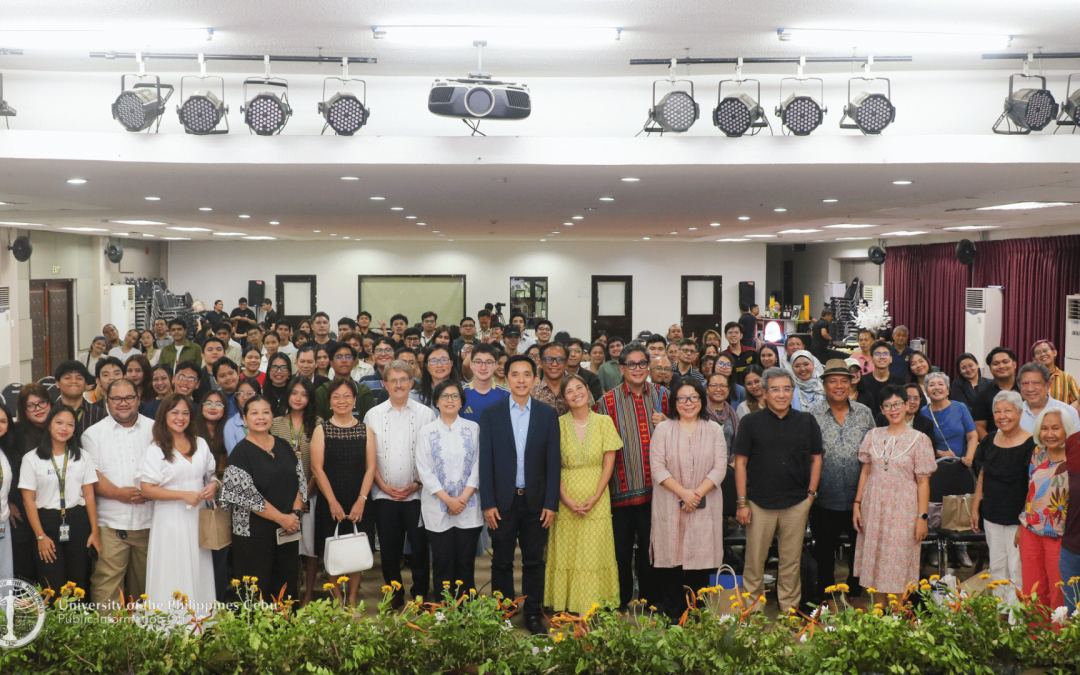
The University of the Philippines Cebu, through its Political Science and Public Affairs programs under the College of Social Sciences, in partnership with the Yuchengco Center at De La Salle University, successfully hosted the international symposium “Southeast Asia’s Diverse Political Terrains: Challenges of Democracy and Development through the Prism of Time” on July 17, 2026, at the Performing Arts Hall.
The symposium brought together leading scholars, faculty members, students, researchers, and guests from various higher education institutions, including state universities and colleges outside Cebu Province, for an afternoon of discussions on the historical and contemporary forces shaping democracy, governance, and development across Southeast Asia. Through comparative perspectives from different country contexts, the event highlighted the region’s political diversity and the enduring challenges confronting democratic institutions, state formation, and public governance.
The program featured two panel discussions showcasing research on key political developments across Southeast Asia. The first panel examined political dynasties and urban governance through presentations by Dr. Prajak Kongkirati of Thammasat University, Dr. Cleo Anne Calimbahin of De La Salle University, and UP Cebu’s Dr. Weena Gera, whose studies explored the historical, institutional, and local dimensions of political power in Thailand and the Philippines.
The second panel turned to contemporary political transformations in Malaysia, Indonesia, and Myanmar. Presentations by Dr. Azmil Tayeb of Universiti Sains Malaysia, Dr. Eunsook Jung of the University of Wisconsin–Madison, and Dr. Ardeth Maung Thawnghmung of the University of Massachusetts Lowell examined themes ranging from religious populism and gender politics to emerging forms of governance and territorial control amid political conflict. Each panel concluded with an open question-and-answer session, allowing participants to engage the speakers in discussions on the comparative political dynamics shaping the region.
The main feature of the symposium was the concluding keynote lecture by Professor Emeritus Paul D. Hutchcroft of the Coral Bell School of Asia Pacific Affairs at the Australian National University. Widely regarded as one of the foremost scholars of Philippine and comparative Southeast Asian politics and political economy, Professor Emeritus Hutchcroft has devoted decades to examining democratic governance, state formation, decentralization, and political institutions in the region. His scholarship has significantly influenced the study of Philippine politics and continues to inform research on governance and development across Southeast Asia.
As part of his scholarly contributions, Hutchcroft has maintained enduring academic collaborations with researchers in the Philippines, including UP Cebu’s Professor Weena Gera, with whom he has worked on various research initiatives. He has also served as Visiting Professor for the Political Science Program of UP Cebu in AY 2023. In his talk “Southeast Asia’s Oldest: The Underappreciated Historical Continuity of the Philippine State”, Professor Emeritus Hutchcroft argued that “no other state in Southeast Asia can claim greater historical continuity in its present-day juridical boundaries than can the Philippines. He specified that, “… to a very significant extent (Sulu excepted), the current juridical boundaries of the Philippines have their origins in the 18th century and were then backed up more concretely in the early to mid-19th century. No other state in Southeast Asia, insular or mainland, can claim such juridical longevity.” In light of the current geopolitical context, this critical assertion by Professor Hutchcroft can certainly be used as one more asset in ongoing efforts to protect the country’s territorial integrity from external aggression.
The symposium likewise brought together an academic community shaped by his scholarship, with several participating speakers having collaborated with or been mentored by Hutchcroft during their academic careers, particularly at the University of Wisconsin–Madison and the Australian National University. Their participation reflected the lasting impact of his work in advancing comparative research and fostering scholarly collaboration across institutions and national boundaries.
Following the keynote, UP Cebu Chancellor Leo B. Malagar and Vice Chancellor for Academic Affairs Palmy P. Tudtud presented Professor Hutchcroft the UP Oblation in recognition of his contributions to the University. This was promptly followed by the commissioners from the Cebu City Cultural and Historical Affairs Commission, who announced the official Cebu City Council resolution conferring upon Hutchcroft the title of “Adopted Son of Cebu City” in recognition of his longstanding contributions to the study of Philippine and Cebu politics and his enduring engagement with Cebu’s academic community. The tributes, which culminated with Serenata’s very beautiful rendition of Usahay, served as a fitting conclusion to a gathering that celebrated not only rigorous scholarship but also the collaborative networks that continue to strengthen political science research in the region.
The symposium highlighted the value of academic collaboration in deepening conversations on Southeast Asian politics and governance. Building on the successful partnership, UP Cebu and the Yuchengco Center look forward to future endeavours that will continue to bring together scholars, researchers, and students in meaningful academic exchange.