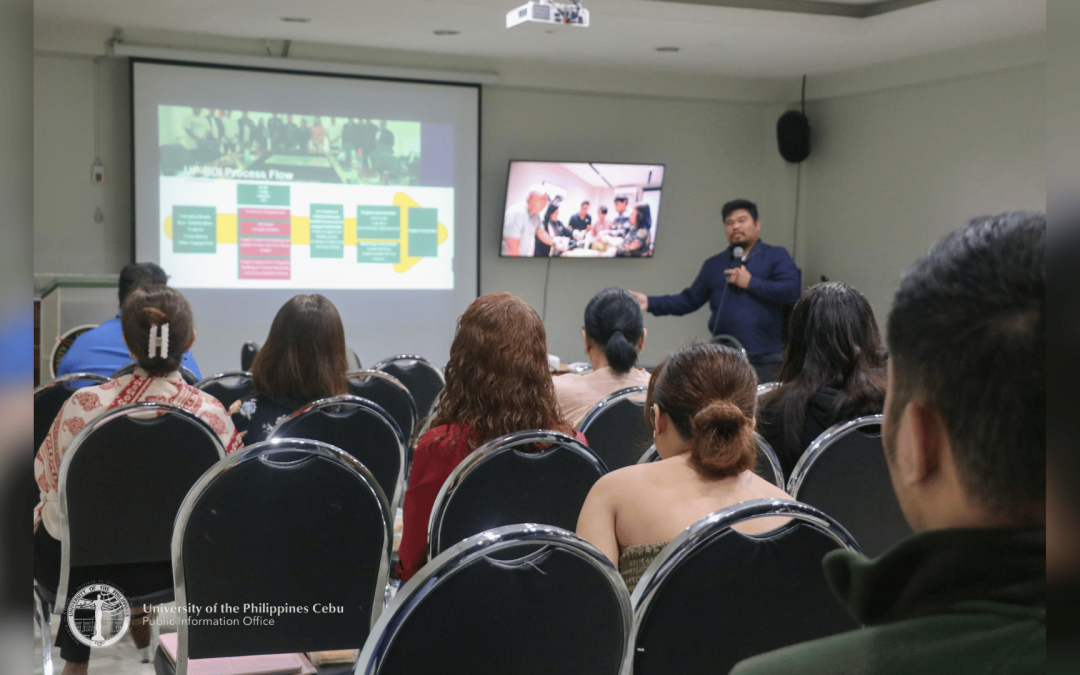
By strengthening the role of higher education in advancing inclusive and evidence-based development, the University of the Philippines Cebu hosted the UP-Bangsa Development Institute (UP-BDI) Caravan on July 31, 2026. Held at Audio Visual Room 1, this event brought together faculty members, REPS, administrative staff, and students to explore opportunities for research, extension, and academic collaboration in the Bangsamoro Autonomous Region in Muslim Mindanao (BARMM).
The program was moderated by UP-BDI Program Coordinator Assistant Professor Maynard Usares and opened with welcome remarks and a message of support from UP Cebu Vice Chancellor for Academic Affairs Asst. Prof. Palmy Tudtud.
Participants were introduced to the UP-BDI, which presented the overview of its mandate and initiatives, including its origins from Administrative Order No. PAJ 23-74, which created the Technical Working Group for the establishment of the institute. The discussion highlighted the role of the University of the Philippines as the national university in contributing to sustainable and inclusive development through multidisciplinary research, innovation, technical assistance, and policy support.
The session also provided context on challenges confronting BARMM and the Sulu Archipelago, including the long-term impacts of conflict, socio-economic disparities, and gaps in institutional capacity and knowledge exchange. Against this backdrop, speakers presented the Bangsamoro Development Plan 2023–2028, outlining priority areas where the expertise of the UP community can help strengthen governance, expand opportunities, and improve the delivery of programs and services through collaborative, evidence-based initiatives.
UP Cebu participants learned from UP-BDI about several existing engagements across the UP System. Featured initiatives included Project SARAI of UP Los Baños, in partnership with the Ministry of Agriculture, Fisheries, and Agrarian Reform (MAFAR-BARMM). This project applies data-driven technologies to support agricultural development. Another initiative is UP-BDI and UP Manila’s telemedicine initiative in Tawi-Tawi, which expands access to healthcare in geographically isolated communities. These discussions also featured presentations on thematic areas for collaboration and ongoing engagements, demonstrating how research and extension projects can respond directly to regional needs through sustained partnerships.
The caravan concluded with a productive open forum, where participants expressed keen interest in developing research proposals and extension initiatives for BARMM. Discussions centered on pitching project ideas, identifying thematic areas of collaboration, and navigating opportunities for engagement with partner communities and institutions.
Through the UP-BDI Caravan, UP Cebu opened new opportunities for faculty, researchers, and students to contribute to BARMM through research and extension. The program showed how collaboration among universities, government, and communities can help promote peace, support more inclusive development, and strengthen institutions. These initiatives help to create possibilities that strengthen UP Cebu’s mission of reaching out to serve marginalized communities.