Message for UP Day of Remembrance 2026
by Chancellor Atty. Leo B. Malagar
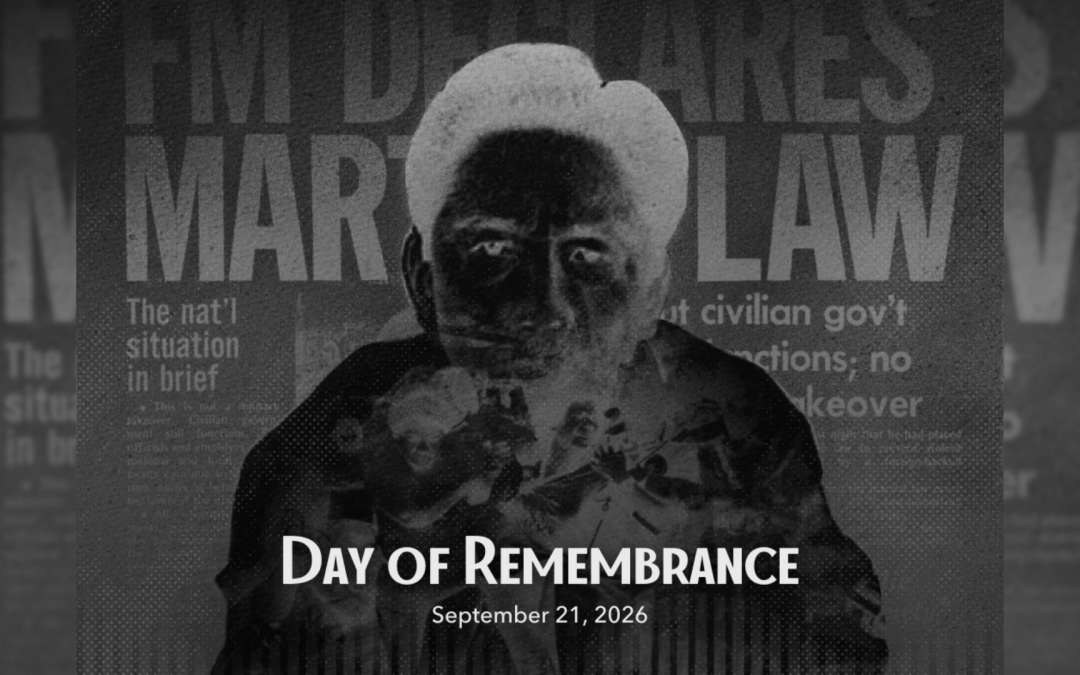
On the 54th anniversary of Proclamation No. 1081, dated 21 September 1972, the University of the Philippines Cebu joins the nation in remembering those who suffered under Martial Law and the dictatorship of Ferdinand E. Marcos, and honoring those who resisted its abuses.
We remember because there are things a nation cannot afford to forget.
We remember the censorship and repression. We remember the violations of human rights. We remember the corruption and abuse of power.
We remember the lives disrupted, the families wounded, the voices silenced, and the freedoms taken away.
But we also remember courage.
We remember those who refused to remain silent. Those who documented what was happening. Those who questioned what they were told. Those who defended human dignity and democratic freedom. And those who preserved truth even when truth had become dangerous to speak.
Their courage reminds us that memory is not passive. To remember requires courage, care, and responsibility.
More than five decades later, remembrance must ask something harder of us.
We often say:
Never Forget. Never Again.
But what do those words require of us?
Never Again requires us to recognize and resist abuses of power that threaten human dignity, democratic freedoms, and accountable institutions. It means refusing both these abuses and the conditions that allow them to take root:
Power without accountability. Corruption treated as ordinary. Public resources diverted for private gain.
People disappearing without answers. Lives taken without justice.
Institutions becoming unwilling—or afraid—to question those who hold power.
Political and economic power so concentrated that meaningful access to opportunity and resources remains beyond the reach of too many Filipinos.
The formal period of Martial Law ended. But the conditions that enable abuse of power can outlast the regimes that exploit them.
History does not have to repeat itself exactly for history to warn us. The names, methods, and circumstances may change.
This does not mean that every problem in the present is identical to what happened under Martial Law. It means that history teaches us to recognize the dangers of corruption, impunity, unchecked power, weakened institutions, and silence in the presence of abuse.
So remembrance cannot ask only what happened then. It must also ask:
What do the lessons of that history require of us now?
An eexamination of the University’s conscience
The University of the Philippines has long exercised the freedom—and accepted the responsibility—to question power.
But criticism is incomplete without self-criticism.
If we take seriously our responsibilities as the national university, then we cannot demand accountability from society without also being prepared to account for ourselves.
Have we lived by the values we teach? Has our knowledge reached those who need it most? Have we spoken when truth required us to speak?
Have we challenged corruption, inequality, impunity, and abuses of power? Have we used our teaching, research, and public service to widen access to knowledge, opportunity, and resources?
And have there been moments when silence, comfort, accommodation, or institutional caution kept us from doing what needed to be done?
These are uncomfortable questions. But a university committed to truth must also ask them of itself.
Our graduates enter government, business, law, education, media, science, and the professions. They write policies, lead institutions, manage resources, and make decisions that affect people’s lives.
They exercise power. That reality should also lead us to examine how we prepare them—and how we exercise authority within the University itself.
Through silence, indifference, accommodation, or inaction, we risk becoming part of the problems we later condemn.
We examine ourselves because we believe deeply in what UP stands for.
A university that demands accountability must also be prepared to account for itself. A university that questions power must also examine how it exercises its own power. A university that asks society to change must remain willing to change itself.
For UP Cebu, this means explaining our decisions, protecting the freedom to question those who lead us, using public resources responsibly, and addressing grievances fairly. These obligations apply to the Office of the Chancellor as much as to every other part of the University.
That is why Never Again cannot remain a slogan.
Never Again is a responsibility
A responsibility to question power, expose wrongdoing, demand transparency, defend human dignity, strengthen institutions, and refuse to become comfortable with injustice.
This is also why truth matters.
We live in a time when information reaches us faster than ever, when technology can produce convincing words and images almost instantly, and when repetition can make falsehood appear familiar enough to be accepted.
But speed is not truth. Repetition is not evidence.
A university must therefore keep asking: Is this true? What is the evidence? Whose story are we hearing? Whose voice is missing? Who benefits? And what are we being asked to forget?
Education must teach us how to question, verify, listen, recognize the limits of what we know, and speak when truth and human dignity demand it.
Here in Cebu, remembrance must also make room for our own history. Our communities carry stories of struggle, dissent, silence, courage, and civic engagement. These Cebuano experiences belong to our nation’s memory and deserve to be preserved, studied, and understood.
This is why the 1081 Exhibit matters. Our students are preserving memory. They are asking what happened, why it happened, what made it possible, and what those experiences ask of us today.
This year’s theme captures that task:
Ang kamatuoran taliwala sa kangitngit.
Truth amid darkness.
Truth may be hidden beneath noise, distorted through repetition, or made inconvenient or uncomfortable. But darkness does not make truth disappear. And silence does not erase what happened.
This is why remembrance must lead to accountability.
Sustained abuses of power are made possible by systems, institutions, decisions, and people—those who order, carry out, enable, or justify abuses, and those who choose to look away.
We cannot honor those who suffered while refusing to confront responsibility.
Accountability begins when truth is met with responsibility.
Those responsible for abuses must answer for them. Those who enabled abuses must confront the roles they played. Reconciliation, when it is sought, cannot be built upon denial.
Truth must come first. Acknowledgment must come first. Responsibility must come first.
Reconciliation cannot substitute for accountability.
The organizers of this commemoration speak of Pahinumdom, Pagpamalandong, Pagdan-ag, Pagpalapad, and Pagbatok.
To remember. To reflect. To bring light where there is darkness. To widen the space so that voices pushed to the margins may be heard. And to have the courage to resist when truth, freedom, and human dignity are threatened.
These are not merely obligations to the past. They are responsibilities in the present.
Because the true measure of remembrance is not how strongly we condemn what happened before.
It is what we refuse to tolerate now.
That standard must apply to government, to business, to our institutions, and to us.
This is why we remember.
Not to keep hatred alive, but to keep truth alive.
Not to remain captive to yesterday, but to protect tomorrow.
We preserve memory because future generations deserve the truth. We demand accountability because human dignity must never become the price of unchecked power. And we examine ourselves because remembrance without responsibility changes nothing.
Dili nato kalimtan.
But remembrance is not enough.
Dili nato pasagdan nga mausab.
We will not merely remember.
We must refuse to tolerate abuse or sustain the conditions that make it possible.