
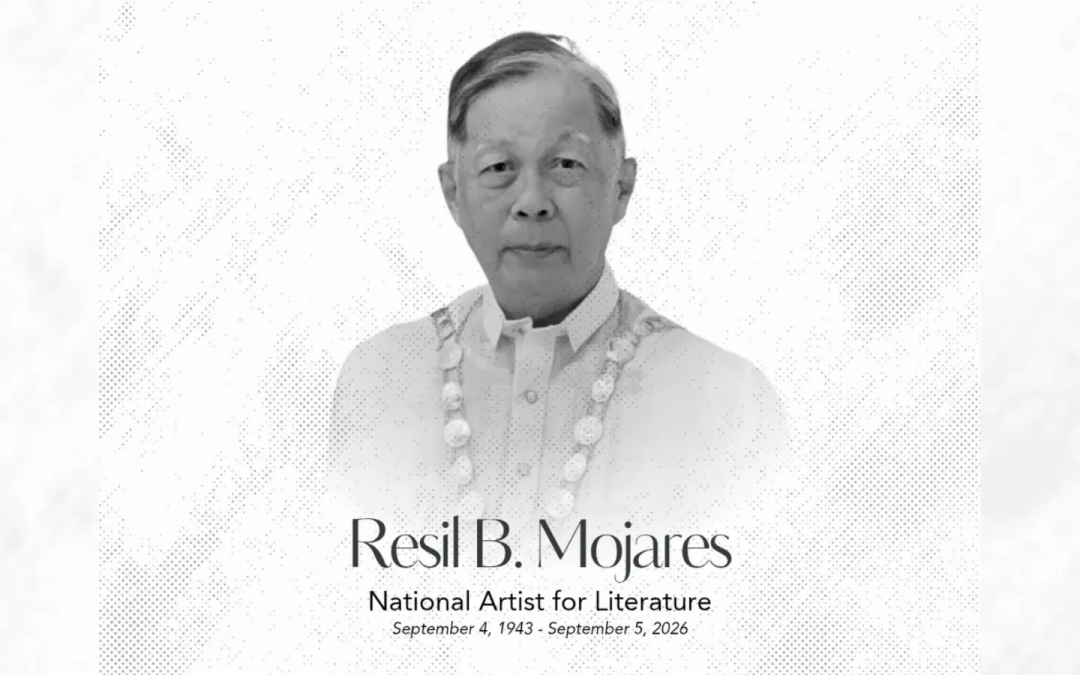
Closing Message for the Tribute to the Life and Work of Resil B. Mojares
(Pagpasidungog sa Kinabuhi ug Buhat ni Resil B. Mojares)
by Chancellor Atty. Leo B. Malagar
Maayong gabii kaninyong tanan.
There is something difficult about speaking at the end of a tribute like this.
Because after everything we have heard tonight—
the stories,
the memories,
the scholarship,
the affection—
what else is there to say?
Many of you knew Sir Resil far better than I did.
You knew the person behind the books.
The teacher behind the scholar.
The friend behind the National Artist.
So I will not try to summarize his life.
I cannot.
And perhaps none of us really can.
But tonight, as I listened, one thought kept coming back to me.
Sir Resil paid attention.
He paid attention to Cebu.
He paid attention to our language.
He paid attention to old newspapers, forgotten writers, small details, neglected stories.
He paid attention to things that many of us would have walked past.
And somehow, because he paid attention—
we learned to see.
We learned to see Cebu differently.
We learned that our stories did not have to come from somewhere else to be important.
We learned that our history did not have to wait for somebody from the center to tell us that it mattered.
We learned something that, perhaps, Cebu has always known in its heart:
Cebu does not need permission to matter.
Sir Resil understood that.
He spent a lifetime showing it—
not loudly,
not dramatically,
but patiently.
Page by page.
Book by book.
Question by question.
He showed us that the stories of ordinary people matter.
That language matters.
That memory matters.
That the places outside the center are not empty spaces on the map.
They are where people live.
Where people struggle.
Where people love.
Where people remember.
Where a country is also made.
Because a country seen only from its center is only partly seen.
And this is why his passing is not only a loss to literature.
It is not only a loss to scholarship.
It is a loss to Cebu.
Because we have lost someone who spent a lifetime looking at this place carefully—
and asking us to look again.
There is a lesson in his life that I keep returning to tonight:
To be rooted is not to be small.
Sir Resil was rooted here.
But his mind was never confined here.
His work could begin in Cebu and reach the Philippines.
It could begin with one forgotten text and open questions about who we are as a people.
He reminded us that sometimes the best way to understand the country is not to begin with the country.
Sometimes, you begin with one place.
One community.
One language.
One story.
And you pay attention.
For those of us in universities, that lesson should make us uncomfortable in the best possible way.
Because we like to talk about knowledge.
We produce it.
We publish it.
We teach it.
But Sir Resil reminds us that knowledge carries a responsibility.
It must mean something to people.
It must help us remember.
It must help us ask better questions.
It must help us recognize what we are in danger of losing.
And whatever we know, we must never stop listening.
At UP Cebu, that responsibility is very real.
We are part of the University of the Philippines.
The national University.
But we are here.
In Cebu.
And that means something.
It means we must know this place.
Not superficially.
Not only through statistics.
Not only through reports.
We must know its people.
Its histories.
Its contradictions.
Its languages.
Its dreams.
Its wounds.
And then we must make that knowledge serve.
Knowledge cannot remain inside the university.
Knowledge must travel.
From the archive to the classroom.
From the classroom to the community.
And finally, back to the people.
Otherwise, what is all that knowledge for?
That is what gives scholarship its public meaning.
And that, to me, is one of the challenges Sir Resil leaves us.
Because the question tonight cannot simply be:
How will we remember him?
But remembrance alone is not enough.
Of course we will remember him.
His books will remain.
His essays will remain.
His name will remain.
The harder question is:
What will we do because he was here?
What will we notice that we once ignored?
What will we preserve before it disappears?
Whose story will we take seriously?
What difficult truth will we have the courage to pursue?
What young person will we teach to ask—
Is this true?
And then to keep asking until the easy answer gives way to the honest one.
That is where remembrance becomes responsibility.
And for UP Cebu, our answer must be clear:
We continue.
We continue to study Cebu.
We continue to protect its memory.
We continue to make room for voices that are easily ignored.
We continue to ask questions even when the answers are uncomfortable.
We continue to teach our students not simply to know more—
but to see more.
To listen more.
To care more.
Because perhaps that is what Sir Resil gave us most.
Not only knowledge.
A way of seeing.
A way of looking at a place and saying:
There is something here worth understanding.
A way of looking at a forgotten story and saying:
Someone should remember this.
A way of looking at people on the margins and saying:
You are part of the story too.
To the young people here tonight—
read Sir Resil.
Yes.
Read him.
But please, do not stop there.
Look around.
Look at Cebu.
Look at the Visayas.
Look at the communities we pass every day.
There are still stories waiting.
There are still histories buried in boxes.
There are still voices that have not been heard.
There are still people waiting for someone to pay attention.
Perhaps that someone will be you.
Sir Resil has done his part.
Now—
the work passes to us.
To the writers.
To the historians.
To the teachers.
To the students.
To our institutions.
And to those of us entrusted, even for a time, with universities.
We inherited his books.
We inherited his scholarship.
But more than that—
we inherited a way of seeing.
And with it—
a responsibility.
A responsibility to remember.
To question.
To look again.
To protect truth from carelessness.
To make knowledge serve the people.
And never to assume that a place is too small, a language too local, a story too ordinary, or a person too easily forgotten to deserve our attention.
Sir Resil—
daghang salamat.
For paying attention.
For teaching Cebu to see itself.
For reminding us that our stories matter.
That our language matters.
That our people matter.
And that there is dignity in taking one place seriously enough to spend a lifetime understanding it.
Tonight, your absence will be felt.
Your family will feel it.
Your friends will feel it.
Your students will feel it.
Cebu will feel it.
But your work will not disappear into that absence.
We will carry it.
Sa among hunahuna.
Sa among mga sinulat.
Sa among mga estudyante.
Sa among unibersidad.
Sa among Sugbo.
Sa among nasud.
Sir Resil—
a life has ended.
The responsibility has not.
Dili namo kalimtan.