
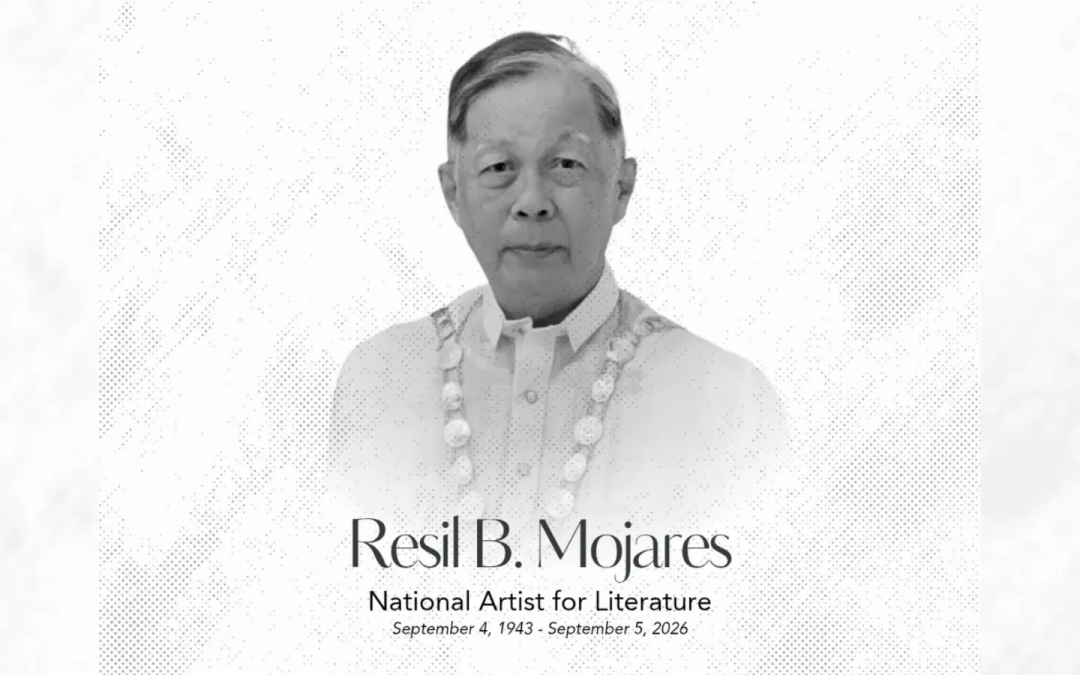
In a published interview in 2019, Resil Mojares said, “The best way of learning about a subject is to write about it.”
For the late national artist, writing was a way of learning. It was also a way of teaching others to look more closely at the Philippines from a different vantage point.
His life as a writer, critic, educator, and journalist was shaped by a sustained curiosity about the people, histories, literature, and cultures that made up the country. Much of that work began in Cebu. But its significance extended far beyond the region.
As a young journalist for The Freeman, Mojares wrote about the social and political unrest in what he often describes as the “long seventies.” His journalism reflects a growing concern with popular struggles, local histories, and the realities of Philippine society. He would be jailed, and his detention became one of the defining experiences of his early intellectual life.
He eventually brought that engagement into academia. After earning his Ph.D. in Literature from the University of the Philippines Diliman in 1979, Mojares developed an academic oeuvre that crossed literature, history, and cultural criticism. His books, such as Origins and Rise of the Filipino Novel, Theater in Society: Society in Theater, Brains of the Nation, Isabelo’s Archive, and Enigmatic Objects, examine the ways Filipinos remember, create knowledge, and understand their society.
Even after garnering national recognition, Cebu remained central to his works. In 1975, Mojares founded the Cebuano Studies Center – arguably the first university-based local studies repository in the country – at the University of San Carlos. He helped create an institutional foundation for the study, preservation, and translation of the Cebuano language, literature, history, and culture. The work that began at the center helped place Cebuano and Visayan materials within broader national scholarly conversations.
His approach to teaching was no less consequential. Mojares argued that literature education should cultivate a creative and critical mind rather than simply accumulate information. He believed that Philippine literature could be a way into worlds, and that students could better understand the wider milieu by taking their own literary and cultural contexts seriously.
His unique understanding of Filipino nationhood and Cebuano culture makes his contributions endure. Mojares did not simply add books to Philippine scholarship. He helped change the questions scholars were willing to ask. He gave greater attention to regional knowledge, local archives, and overlooked writers and histories that might otherwise have remained at the margins. His work helped make Cebuano scholarship an important part of the process of redefining the Philippines itself.
In 2018, the Philippine government conferred on him the title of the National Artist for Literature. Yet the significance of his life extends beyond this distinction. It lives in the classrooms he influenced, the archives he helped build, the scholars he inspired, and the readers who learned to see the country with greater care.
Dr. Mojares passed away on the 5th of September 2026, a day after his 83rd birthday. His passing is a profound loss to Cebu and to Philippine culture and letters. But his contributions have already become essential to the Filipino intellectual life he spent a lifetime examining.
As the University of the Philippines Cebu approaches its Day of Remembrance, Mojares’ academic oeuvre serves as a memento that should guide our academic community to the principles he emphasized: remain rooted in the local, reach out to the margins, and serve the communities we live in.
He wrote about Cebu. In doing so, he helped the Philippines understand itself a little better. He wrote, taught, questioned, and shared what he learned. The work of learning continues in those who carry his questions forward. His wisdom has helped shape the Filipino consciousness.
He may have laid down his pen, but the work continues. What he wrote taught us to see ourselves more clearly. It is now our turn to write.